deweather is an R package developed for the purpose of “removing” the influence of meteorology from air quality time series data. The package uses a boosted regression tree approach for modelling air quality data. These and similar techniques provide powerful tools for building statistical models of air quality data. They are able to take account of the many complex interactions between variables as well as non-linear relationships between the variables.
Part of the openair toolkit


💡 Core Features
deweather makes it straightforward to test, build, and evaluate models in R.
Test and build meteorological normalisation models flexibly using
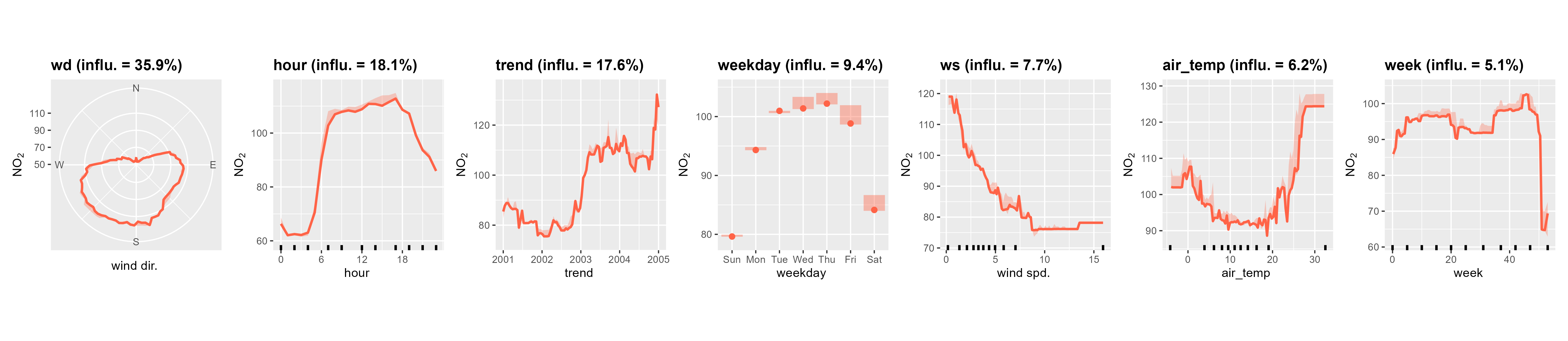
tune_dw_model()andbuild_dw_model().Plot and examine models in a myriad of ways, including visualising partial dependencies, using functions like
plot_dw_importance(),plot_dw_partial_1d()andplot_dw_partial_2d().Apply meteorological averaging using
simulate_dw_met()to obtain a meteorologically normalised air quality timeseries.
Modelling can be computationally intensive and therefore deweather makes use of the parallel processing, which should work on Windows, Linux and Mac OSX.
⌛ Pre-1.0.0 deweather
deweather was overhauled in its 1.0.0 update. We believe this update makes deweather more modern and flexible, but we appreciate users may require access to or prefer the older version.
For this reason, the older, gbm-powered version of deweather can be accessed at https://github.com/openair-project/deweather-archive.
Note that the above repository is provided for archival purposes only, and is unlikely to recieve any future feature updates.
📖 Documentation
All deweather functions are fully documented; access documentation using R in your IDE of choice.
?deweather::build_dw_modelDocumentation is also hosted online on the package website.

A guide to the openair toolkit can be found in the online book, which contains lots of code snippets, demonstrations of functionality, and ideas for the application of openair’s various functions.

🗃️ Installation
deweather is not yet on CRAN.
The development version of deweather can be installed from GitHub using pak:
# install.packages("pak")
pak::pak("openair-project/deweather")
🏛️ deweather is primarily maintained by David Carslaw.
📃 deweather is licensed under the MIT License.
🧑💻 Contributions are welcome from the wider community. See the contributing guide and code of conduct for more information.